Showing posts with label religion. Show all posts
Showing posts with label religion. Show all posts
Friday, May 11, 2012
What was The Protestant Reformation?
The Protestant Reformation changed religious attitudes
Around 1500 a number of northern humanists were suggesting that the Church had lost sight of the spiritual mission proclaimed by Jesus himself. Instead of setting an example of moral leadership, they said, popes were becoming political leaders and warriors. Instead of encouraging inner piety, priests were concerned about the details of ceremonies. And the Church as a whole, they said, seemed more interested in its income than in salvation. What the northern humanists were seeking was a new emphasis on personal faith and spirituality. When their message went unheard in the Church, a new generation of reformers urged believers who were unhappy with official religion to join a new church. This religious revolution, which split the Church in Western Europe, is called the Reformation.

Saturday, April 21, 2012
What is the Society of Friends?
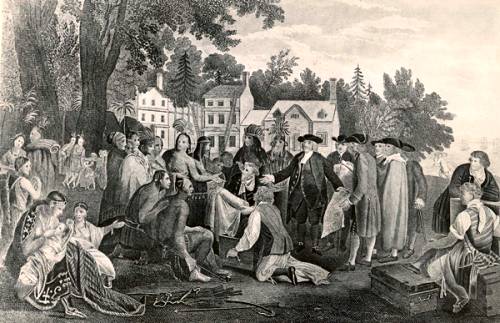 |
| Colonial Quakers |
Saturday, April 14, 2012
What is a friar?
Friar is the popular distinguishing title of the members of the mendicant orders. The first friars were the Franciscans or Grey Friars and Dominicans or Black Friars. To these were added the Carmelites or White Friars by Innocent IV (1224), and the Augustinian hermits or Austin Friars by Alexander IV (1256). In the 15th century the Serviles and Trinitarians or Crutched Friars were granted the same privileges as the four mendicant orders.


Franciscan friar
Tuesday, March 27, 2012
What are the Lindisfarne Gospels?
 |
| Lindisfarne Gospel |
During the early Middle Ages, monks were among the few people in Europe who could read and write. Almost all books dating from this period were written out by hand in monastery workshops. In this age of great faith, the work that was copied most often was the Bible. The monks were painstakingly careful, for a manuscript containing the word of God was consid¬erad to be a sacred object whose visual beauty should reflect the importance of its contents. To glorify God, the monks illuminated, or illustrated, the pages with gold leaf and intricate designs.
The Lindisfarne Gospels are among the most beautiful of the early illuminated books. They were produced around 700 a.d. in the monastery of Lindisfarne. Now called Holy Island, Lindisfarne is off the northeastern coast of England. It was one of England's early centers of learning.
The image shown here is the beginning of the Gospel According to St. John, part of the New Testament. Interlaced ribbons, circles, and other designs decorate the border of the page and the words. The Latin words mean, "In the beginning was the Word, and the Word was with God."
Monday, March 5, 2012
Who were the Lollards?
Lollards were originally a religious group of the early 1300's in Holland. About 1387, the term began to be used as a name for the followers of the English religious reformer John Wycliffe. The Lollards preached obedience to God, reliance on the Bible as a guide to Christian living, and simplicity of worship. They rejected the richness of the Mass, most sacraments, and papal supremacy. They denied that an organized church was necessary for salvation. Most Lollards were poor priests or laymen. They wore long russet gowns, carried staffs, and lived on what they could beg. Henry IV, who became king in 1399, persecuted the Lollards because their views disagreed with religious law. By 1420, their movement had been practically stamped out.
The Lollards had little permanent effect on religious life in England, but they had great influence in Bo¬hemia. There, John Huss was burned at the stake in 1415 for preaching Wycliffe's doctrines. One hundred years later, Martin Luther embraced some of Huss's ideas. In this way, the Lollards helped to pave the way for the Protestant Reformation.
The Lollards had little permanent effect on religious life in England, but they had great influence in Bo¬hemia. There, John Huss was burned at the stake in 1415 for preaching Wycliffe's doctrines. One hundred years later, Martin Luther embraced some of Huss's ideas. In this way, the Lollards helped to pave the way for the Protestant Reformation.
Saturday, January 7, 2012
What does Hegira mean?
Hegira, or Hijra, is a term referring to the flight of Muhammad from Mecca, in June, 622 A.D. After its flight he became ruler of Yathrib, later called Medina, and there laid the foundation of Islam. The Moslem calen¬dar begins with that year.
Technically, the first Hegira occurred in 615 A.D. when a group of Muslims was counseled by Muhammad to escape persecution in Mecca and travel to the Kingdom of Axum, which was ruled by a Christian king. Muhammad himself did not join this emigration.
Technically, the first Hegira occurred in 615 A.D. when a group of Muslims was counseled by Muhammad to escape persecution in Mecca and travel to the Kingdom of Axum, which was ruled by a Christian king. Muhammad himself did not join this emigration.
Tuesday, December 27, 2011
What is the Last Judgment?
In Judaism, Christianity, Islam, and Zoroastrianism the Last Judgment is the judging of the living and dead by God at the end of the world. Roman Catholics call this the General, or Last, Judgment. They distinguish the Last Judgment from the Particular Judgment, which assigns each individual immediately after death to a temporary place in Heaven, Purgatory, or Hell while awaiting the Last Judgment. Similar to the Catholic concept of a Particular Judgment are the Muslim and Zoroastrian doctrines of a preliminary test of faith that each person undergoes shortly after death.
 |
| The Last Judgment by Michelangelo |
Wednesday, December 21, 2011
What are the last rites?
The last rites is a popular term for the Roman Catholic sacraments given to the sick, particularly to those who are in danger of death. The rites consist of penance, or confession and absolution, the viaticum, or last Communion, and extreme unction, or anointment with oil and a blessing.
 |
| Last Rites |
Wednesday, December 7, 2011
What is sin?
A sin is a lack of conformity to, or transgression of, a law believed to have divine sanction. Some doctrine of sin and of reconciling the deity is part of most religions. Zoroastrianism premises a conflict of sin with holiness. The central doctrine of Buddhism turns on the demerit of human actions, which must be purged by transmigration.
In no sacred books is the sense of sin so developed as in the Bible. Throughout the Scriptures sin appears as that element in man which puts him at enmity with God, and requires the work of a Redeemer.
Read more »
In no sacred books is the sense of sin so developed as in the Bible. Throughout the Scriptures sin appears as that element in man which puts him at enmity with God, and requires the work of a Redeemer.
Read more »
Wednesday, October 5, 2011
Who was Goliath?

and the stone sunk into his forehead," and he fell to the earth. Then David ran and stood upon the giant, took his sword and cut off his head which he carried to King Saul. The Philistines, seeing their cham¬pion dead, lost heart and took to flight. The Israelites pursued them, returning victorious.
Subscribe to:
Posts (Atom)